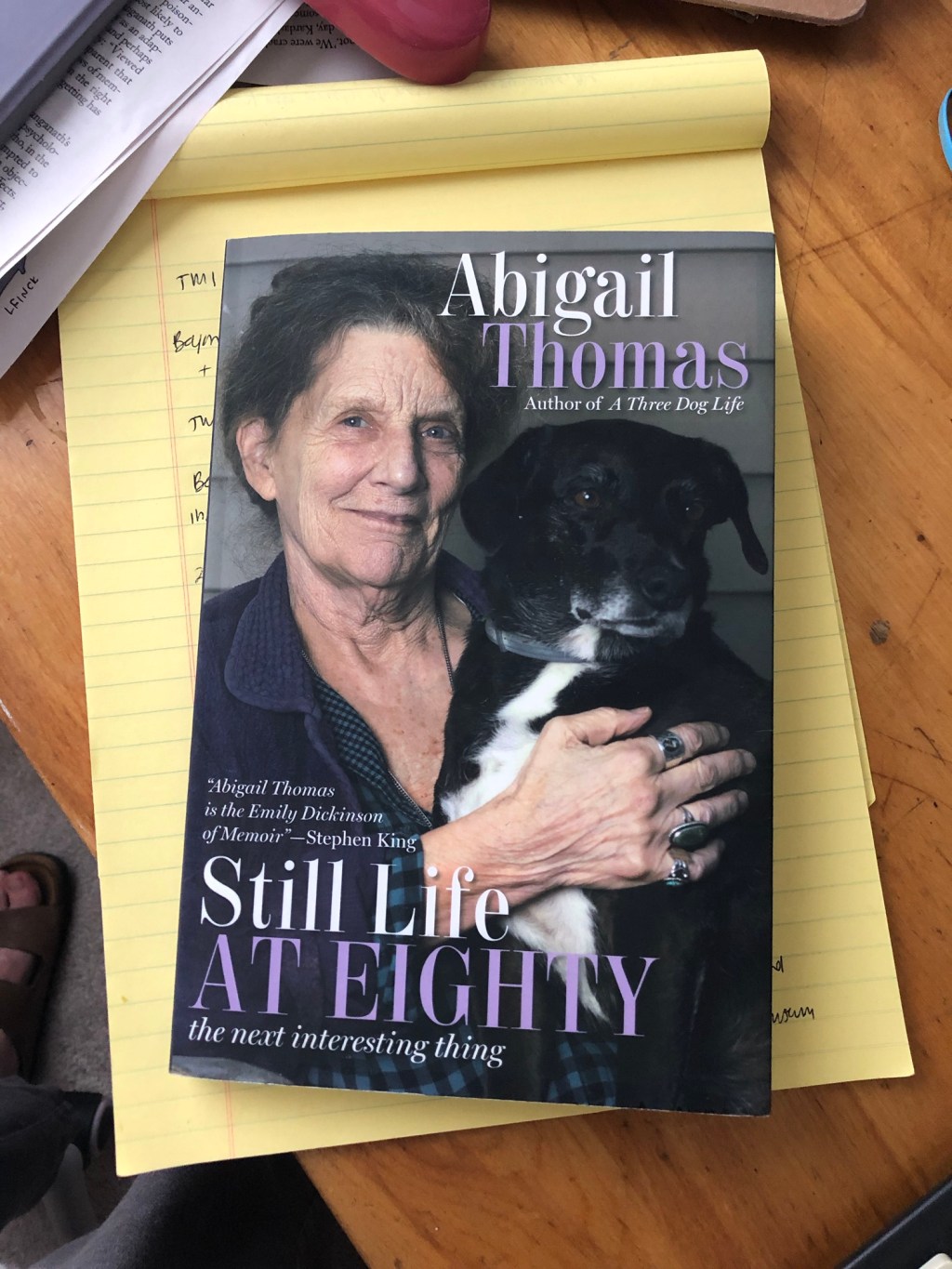
I’ve read many books by Abigail Thomas, and for anyone looking to write short-form nonfiction that coalesces into a book of essays, her work is an excellent model.
In these excerpts from her most recent book, Still Life at Eighty, she describes the book-writing process; writer’s block; using third person point of view; and writing as discovery. There’s a writing prompt at the end.
Here, she describes writing in diaries during a difficult time, entries that became a book.
“Writing things down is not the same as writing, but experience put raw on the page kept me sane during a time of trauma. My hand holding the pen, the pen against the paper, here was something familiar I could do, and it calmed me. My diary went with me everywhere, and every tiny thing I felt or heard and hoped and saw, I wrote it down. Eventually I wrote a book about those years, my husband’s tragic accident, how our world changed. The book, A Three Dog Life, would never have been written had it not been first scratched into dozens of diaries.” –from “Diaries,” page 17.
Here, she describes feeling stuck, not writing, and then getting unstuck.
“Another rainy day in a long succession of rainy days and I’m bummed that the part of myself that has always kept me company seems to have disappeared. here we are in the middle of a pandemic, I haven’t left the house in ages, and I can’t write a word. What’s the point of being me? I wonder. I’m so stuck. Write about what you notice when you’re stuck, I tell my students. Write about what you notice and see what happens. Nothing happens here except bugs. For instance: I often see one large black ant wandering across the living room in early evening…” –from “Paper Wasps,” 55.
The description of an ant leads to a full meditation. Imagining her stuck, noticing an ant, I think of Virginia Woolf sitting at her writing desk watching a moth at the window, which became the essay, “The Death of the Moth.”
Here, Thomas writes in the third person about feeling anxious because she’s about to be interviewed about a nonfiction piece she wrote in the third person. Thomas often switches between first and third person in her books of essays.
“She can’t explain why she writes the way she writes. If she’d stayed in college she would have the right words. The concepts. But she left halfway through freshman year and never went back. Take this piece she’s writing now. Why is it in third person? She is sitting right there in her chair, it’s her fingers on the keyboard, why doesn’t she say so? Well, sometimes she needs to see herself in the distance, the past, for example, or the future, or in a sorry mood. And sometimes when the first person can’t think straight, the third person steps in. Also, she gets tired of herself, all that me me me. The third person is always handy, always willing. And it knows more than she does.” –from “Interview,” 88.
Aren’t we usually told to pick a perspective and stick with it? Well, Thomas doesn’t.
Her use of third person for personal narrative reminds me of one of my favorite passages from Lydia Davis’s novel, The End of the Story, in which she discusses switching perspective as part of the writing process, but not the final product. Switching to third person can afford us distance from things that are difficult to face, or write.
“Certain things I wrote down in the first person, and others, the most painful things, I think, or the most embarrassing, I wrote down in the third person….I went on in the third person, and after a time it became bland, and harmless…So that after it had been in the third person so firmly that I could be convinced it had happened to someone else, and take it back into the first, claiming, as though falsely, that it had happened to me.” (Sorry, I xeroxed this page from the novel years ago and didn’t include the page number!)
One thing I love about Abigail Thomas is the sense of immediacy–we’re dropped into her mind in a particular circumstance, and off we go. She captures the sense of uncertainty and discovery in the writing process.
“I’ve been writing something I don’t understand yet, and what I’m following (or being led by), might have laid down its tracks fifty years ago, or yesterday. If you could map my mind, it would resemble the zig-zagging dog’s prints in an inch of snow: how I spent my allowance in New Orleans? The waterfall in Sneden’s? The boy in New Hampshire? It might be anything, but my whole life has brought me here. That’s what’s so interesting about writing. I veer left, then right, then straight ahead, stopping occasionally to examine something more closely.” –“These Dogs I Love,” 140.
And, speaking of uncertainty, try this as a writing prompt:
“A friend asks me an interesting question. What were you once certain of, she wants to know, that you can no longer count on?” –“An Interesting Question, 153.
 Writing Trouble
Leave a comment